jueves, 22 de diciembre de 2011

Finding constellations…


With this set of directions, you should be able to find all of these with great ease!!


 Instructions

1. Taurus (the Bull)- This constellation appears to be a "V". It is most easily found by looking at Orion's belt stars (three stars in a line). Trace a line through these stars and follow it to the right until you hit a bright red star. This star is called Aldebaran, and is the eye of the Bull. The "V" it is part of is Taurus.

2. Gemini (the Twins)- This constellation can also be found by using Orion. When looking at Orion, you will see the three belt stars surrounded by four stars marking Orion's feet and shoulders. The lower right star is the bright blue star Rigel. The top left star is the red giant Betelgeuse. Starting at Rigel, going through the middle belt star, onto Betelgeuse and continue in this line will bring you to two stars of equal brightness. These are Castor and Pollux, the stars that make up Gemini.

3. Cancer (the Crab)- This is the single hardest constellation to find in the night sky. It requires a completely dark sky. The constellation itself looks like an upside-down "Y". The best way to find Cancer is to find Taurus and Gemini, draw a line through them and continue on to the left until you come to a big empty spot in the sky (it won't take long). The big empty spot is Cancer!

4. Leo (the Lion)- Using the same method you just used to find Cancer, keep tracing that line until you hit a backward question mark followed by a triangle. This is the stately Leo. The bright star at the end of Leo's tail is Denebola, which means "the tail". If you cannot find Taurus and Gemini, use the Big Dipper to help you find Leo. Use the two pointer stars that help you find the Little Dipper, only this time trace them away from the North Star. These two stars will lead you to the triangle part of Leo.

5. Virgo (the Maiden)- This is another constellation that is easily found off the Big Dipper. Start with the Big Dipper. Trace the handle away from the "bowl", and follow the arc to the bright star Arcturus. From there, continue on to the blue star Spica. Spica appears to be the center of a "Y"-shaped constellation. This constellation is Virgo.

6. Libra (the Scales)- Another constellation best located using the "draw a line around the sky" method, Libra looks like a square standing on one corner. The fun part of this constellation are the stars to the left. Both have rather long Arabic names: Zubenelganumi and Zubeneshameli.


7. Scorpio (the Scorpion)- Again, draw an imaginary line through the constellations you have already located until you reach a constellation that looks like a fishing hook with a bright red star in the middle of it. The star is Antares, and the constellation is Scorpio. Scorpio has been an important constellation to the people living in the Pacific Ocean. It has been a point of reference for fishermen moving between islands so they could find their way home. Scorpio was also well-known to the Ancient Greeks, and is possible proof of precession (the idea that the night sky has changed over time). The Greeks told a story about the mighty hunter Orion, a favored companion of the goddess Artemis. She spent so much time with him that her brother Apollo became jealous. One day, when Artemis was off with her hunting maidens, Apollo sent a huge scorpion after Orion. A battle ensued, and as Orion was turning to escape the scorpion, it stung him and killed him. When Artemis learned of her friend's death, she was furious with her brother. To make amends with her, Apollo helped her hang Orion in the sky, but he also hung the Scorpion to remind her of the power of his anger. The two played chase around the sky. Today, they still do, but they are never in the sky together.


8. Sagittarius (the Archer)- Beside Scorpio is a cute little constellation that looks like a teapot. This is Sagittarius. A great way to help people see this constellation is to sing the Teapot Song while tracing Sagittarius. When you get to the part that says, "Tip me over and pour me out," trace the "steam" that appears to go through the "spout" of Sagittarius. This is the Sagittarius arm of the Milky Way, and when you look at it, you are looking toward the center of the galaxy.

9. Capricorn (the Goat)- Use that line-drawing method you have been mastering all year to get from Sagittarius to Capricorn. The best way to describe this constellation is to share its common nickname: the "Marilyn Monroe" smile. Capricorn literally looks like the outline of a big smile. Another way to find this constellation is to locate the triangle that the Milky Way goes through. This is the Summer Triangle, and it points right at Capricorn.

10. Aquarius (the Water Bearer)- This is another tricky one to find. Use your line-drawing technique to draw a line from Capricorn to an oval shape of pairs of stars. This is the flowing water of Aquarius.

11. Pisces (the Fish)- This one is tricky, but fun! Use the line-drawing technique to get to a big square (this is a really big square). You are looking for stars that go along two sides of the square, outside the square, that will meet at one corner of the square. At each end of these lines should be a round shape. This is Pisces. It is tricky to see exactly which stars belong to Pisces, and which belong to its fellow constellations Pegasus (the big square) and Andromeda (a "v" off one corner of Pegasus).

12. Aries (the Ram)- This constellation can be found by drawing lines from either Pisces or Taurus. It is the small triangle that is not beside Andromeda (there are two in that area).

How did the constellations get their names?

NameImageMythology
AquariusWater CarrierBabylonian Name.
In Greek mythology, Aquarius (also known as Ganymede in Roman myth) was a beautiful young boy whom Zeus brought to Olympus to be the cup bearer of the Gods. It is suggested that Zeus fell in love with Aquarius.
AriesRam or Golden Fleece.In Greek mythology, the ram carried Athamas's son Phrixux and daughter Helle to Colchis to escape Ino. When the ram reached Colchis, Phrixux sacrificed the ram and hung its fleece in the Grove or Ares. This fleece turned to gold and later was the quest of Jason and the Argonauts.
The constellation name was common in Greek, Babylonian and Egyptian cultures.
CancerCrabJuno sent a crab to defeat Hercules while fighting Hydra. The crab was crushed by Hercules.
CapricornSea GoatAlso known as Amalthea who provided for baby Zeus after Rhea saved him from Cronos.
The word "cornucopia" comes from the broken horn of Capricorn - or the "horn of plenty."
GeminiTwin BrothersThe two bright stars - Castor and Pollux - are also the brothers' names. They were the brothers of Helen of Troy.
They are also the protectors of ships and sailors.
LeoLionPrehistoric constellation associated with royalty. In Egyptian mythology, it represents the life giving floods since the Sun was in this constellation during the heavy rains.
In Greek mythology, Leo represents the Nemean Lion which was killed by Hercules.
LibraScalesThe only "non-living" object in the Zodiac.
Romans chopped claws from Scorpio during Autumn Equinox to make Libra.
In Greek mythology, Libra is the scaled held by Astraea that represents justice.
OphiuchusSerpent HolderWhile not an Astrological sign, Sun spends longer time here than in Scorpio.
In Greek mythology, Ophiuchus is a legendary physician who tried to become immortal to avoid death. Zeus killed him with a bolt of lightening, but honored him because of good works.
PiscesTwo FishVenus and her son Cupid escaped Typhon as two fish tied together.
In Greek mythology, they are Aphrodite and Eros.
SagittariusThe ArcherA Chiron, half-man half-horse, sent to kill the scorpion (Scorpio).
In Babylonian mythology, this represents the demon Pabilsaq.
ScorpioThe ScorpionSent by Gaia to kill Orion when he said he would kill all animals.
It is also said that Apollo sent the scorpion to kill Orion.
Orion and Scorpio are on opposite sides of the sky.
TaurusThe BullBabylonian constellation.
Jupiter turns into bull to carry off Europa - daughter of King of Crete.
It is also said that Zeus brought the ram to try and win the heart of Europa.
VirgoThe VirginGoddess of farms and harvest. Virgo could also represent Ishtar, Isis, Demeter, Cybele, and Athena.
Also thought to represent Astraea, the daughter of Zeus representing justice.
It is also suggested that Virgo represents Persephone, queen of the
underworld.

News

Source of zodiac glow identified

Related images
         

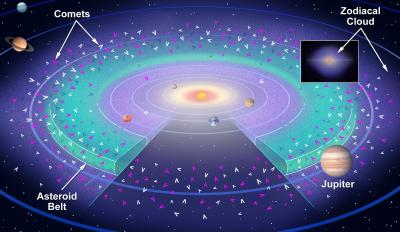
The dust between the planets, that scatters sunlight our way, is not from the asteroid belt (depicted here in green), but from periodically disrupting comets that spend much of their time near the orbit of Jupiter, according to calculations by Nesvorny and Jenniskens.
Southwest Research Institute
The eerie glow that straddles the night time zodiac in the eastern sky is no longer a mystery. First explained by Joshua Childrey in 1661 as sunlight scattered in our direction by dust particles in the solar system, the source of that dust was long debated. In a paper to appear in the April 20 issue of The Astrophysical Journal, David Nesvorny and Peter Jenniskens put the stake in asteroids. More than 85 percent of the dust, they conclude, originated from Jupiter Family comets, not asteroids. "This is the first fully dynamical model of the zodiacal cloud," says planetary scientist Nesvorny of the Southwest Research Institute in Boulder, Colo. "We find that the dust of asteroids is not stirred up enough over its lifetime to make the zodiacal dust cloud as thick as observed. Only the dust of short-period comets is scattered enough by Jupiter to do so."
This result confirms what meteor astronomer Jenniskens of the SETI Institute in Mountain View, Calif., had long suspected. An expert on meteor showers, he had noticed that most consist of dust moving in orbits similar to those of Jupiter Family comets, but without having active dust-oozing comets associated with them.
Instead, Jenniskens discovered a dormant comet in the Quadrantid meteor shower in 2003 and has since identified a number of other such parent bodies. While most are inactive in their present orbit around the Sun, all have in common that they broke apart violently at some point in time in the past few thousand years, creating dust streams that now have migrated into Earth's path.
Nesvorny and Jenniskens, with the help of Harold Levison and William Bottke of the Southwest Research Institute, David Vokrouhlicky of the Institute of Astronomy at Charles University in Prague, and Matthieu Gounelle of the Natural History Museum in Paris, demonstrated that these comet disruptions can account for the observed thickness of the dust layer in the zodiacal cloud.
In doing so, they solved another mystery. It was long known that snow in Antarctica is laced with micro-meteorites, some 80 to 90 percent of which have a peculiar primitive composition, rare among the larger meteorites that we know originated from asteroids. Instead, Nesvorny and Jenniskens suggest that most antarctic micro-meteorites are pieces of comets. According to their calculations, cometary grains dive into Earth's atmosphere at entry speeds low enough for them to survive, reach the ground, and be picked up later by a curious micro-meteorite hunter.

http://esciencenews.com/articles/2010/04/15/source.zodiac.glow.identified